
Can Your Mind Change Reality? A Christian View of Manifestation, Magic, and Prayer
Thoughts matter. They shape attention, interpretation, emotion, planning, and conduct. A person who thinks carefully often acts more wisely than one who refuses to examine reality.
That influence has limits. Concentration cannot command the future, rewrite physical events, or force the universe to deliver a chosen result. The difference between influence and control is essential for both clear reasoning and sound faith.
The human mind can guide human action, but it does not possess God’s authority over reality. Christian renewal trains the mind to recognize truth, make responsible choices, and submit uncertain outcomes to the Creator.
Thought Changes Conduct, Not the Structure of Reality

Thought affects life through understandable paths. What you repeatedly notice becomes easier to remember. What you believe influences the choices you consider. What you practice becomes a habit, and habits shape character and consequences.
For example, a student who expects improvement and follows a study plan increases the likelihood of learning. The expectation did not bend reality. It directed attention, effort, time, and persistence toward a real goal.
The source crosses from this reasonable insight into a metaphysical claim:
All future events are probable and you can affect which probable event manifests with your mind.
By simply concentrating, you can create reality.
This resembles New Thought and contemporary manifestation teaching. New Thought is a diverse modern spiritual movement that gives unusual causal power to thought, belief, visualization, or spiritual alignment. Some forms speak about God; others describe an impersonal universal intelligence. The shared tendency is to treat inner mental states as forces that help produce external conditions.
The supporting idea has an understandable appeal. Expectations influence perseverance, confidence changes social behavior, and focused people recognize opportunities that distracted people miss. Those effects are real, but they do not prove that mental energy selects events from multiple futures.
Historic Christianity treats creation as real and dependent on God, not as a projection that conforms to private expectation. Human beings are creatures within the world. They can cultivate, build, plan, persuade, and destroy, but they do not sustain the laws or future of creation.
Proverbs 16:9 states, “The heart of man plans his way, but the Lord establishes his steps.” The verse holds planning and providence together. Planning is a human responsibility; providence is God’s wise government of creation.
This distinction also protects people from unjust blame. Illness, poverty, abuse, disaster, and loss cannot be reduced to defective thoughts. Choices carry consequences, yet many conditions arise from other people’s actions, bodily limits, social structures, and events outside personal control.
Examine your thoughts, correct false assumptions, make a responsible plan, and judge the result by evidence rather than desire. A renewed mind serves reality by responding truthfully to it.
Quantum Physics Does Not Turn Intention Into Power

Quantum mechanics is a scientific theory used to describe matter and energy at very small scales. A wave function is a mathematical object that represents the possible results of measurements and their probabilities within a quantum system.
The measurement problem asks how a range of mathematically possible results relates to the one definite result an experiment records. Physicists and philosophers offer several interpretations. The word “observer” in this discussion does not automatically mean a human mind willing an event into existence.
The source makes that leap:
This means thatconsciousness can actually choose, to some extent, which outcome actually occurs.
This is a process which is very much like the concept of psychokinesis.
This reasoning belongs to quantum mysticism, which uses language from quantum theory to support spiritual or paranormal claims that the scientific evidence does not establish. Some historical interpretations of quantum measurement gave consciousness a special role, so the association did not appear from nowhere. Yet an unresolved interpretive question is not experimental proof of psychokinesis, manifestation, or control over ordinary events.
A scientific probability describes a model of possible measurement results under defined conditions. It does not mean every desired life event exists as a selectable lane. A job offer, restored relationship, healed body, or lottery result includes complex physical, social, moral, and personal causes that cannot be reduced to a wave function directed by intention.
The source continues:
We can alter probabilities with our mind to shift space time events.
No controlled evidence presented in the source connects focused intention with altered space-time events. The claim borrows scientific vocabulary, but it does not supply a testable mechanism, reliable measurement, or repeatable demonstration.
Christian faith has no need to place divine action inside a gap in scientific explanation. God is Creator and sustainer of the whole order of nature. Miracles in Scripture are acts of God that serve his purposes; they are not techniques activated by mental force.
Scientific uncertainty does not authorize a spiritual conclusion that the evidence cannot carry. Respect for truth requires keeping mathematical description, philosophical interpretation, and religious belief distinct.
Use quantum terms only within their demonstrated meaning, and ask what evidence connects a physical theory to any claim about consciousness or spiritual power. Careful categories prevent impressive language from replacing proof.
Magic Seeks Control Where Prayer Seeks God
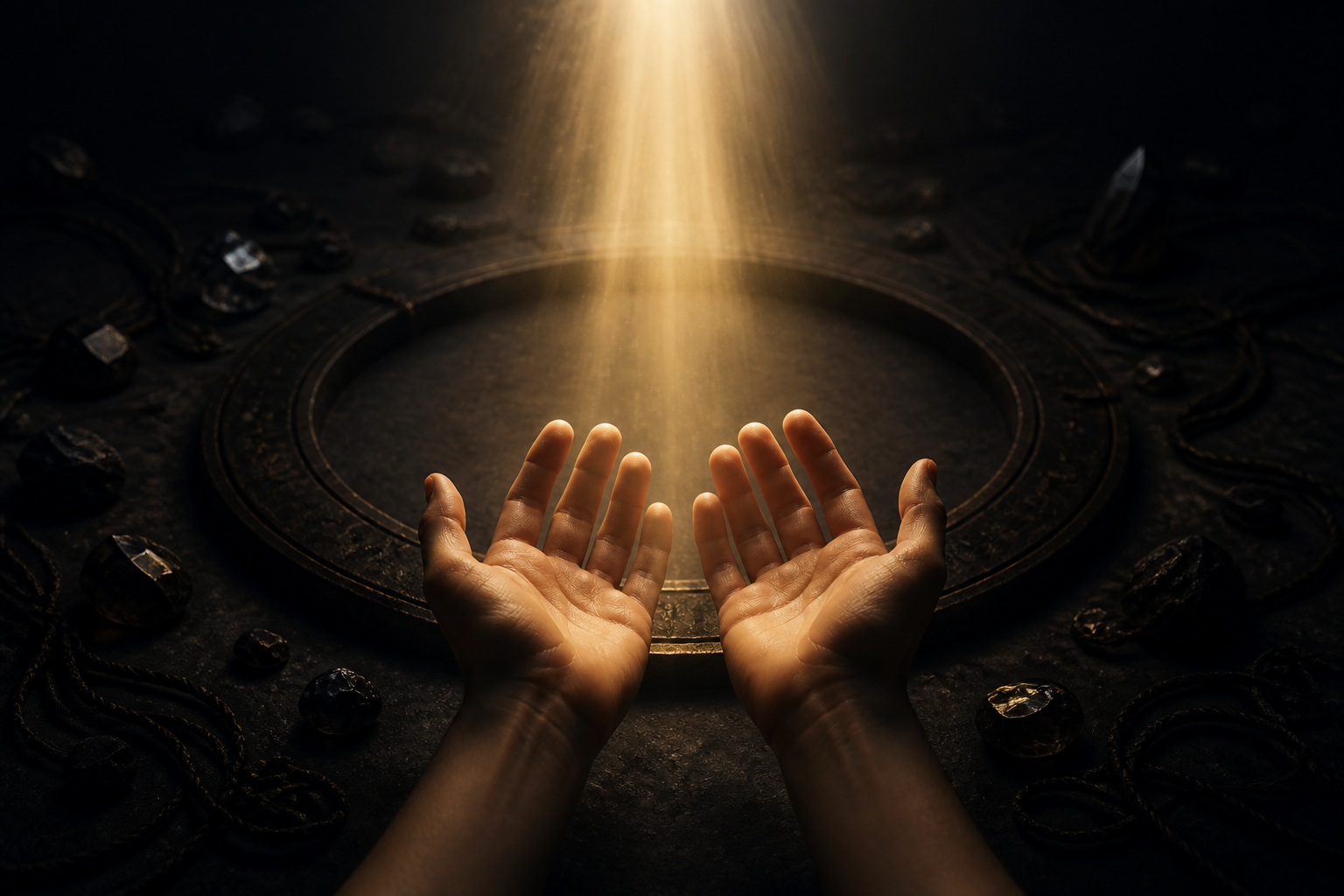
Magic, in the religious sense, is an attempt to influence events through rituals, spells, spiritual forces, symbolic acts, special materials, or directed will. Prayer is personal communication with God that includes worship, confession, thanksgiving, lament, petition, and submission.
Both can involve desire and an unseen reality, but their governing relationships are different. Magic seeks a method that produces an effect. Christian prayer addresses the living God, who hears and acts according to his wisdom rather than human technique.
The source blends these practices:
Sometimes spells work, sometimes they do not. Sometimes prayers produce results. Sometimes they do not. Nothing is infallible.
This comparison treats prayer and spells as uncertain tools for obtaining results. That resembles modern Western occultism and practical magical traditions. The source’s later spelling, “magick,” is commonly used in occult settings to distinguish ritual or spiritual magic from entertainment. These practices vary greatly and do not form one religion, so the wording supports a family resemblance rather than a single precise origin.
The source gives the method greater detail:
Most people know that skill or giftedness enters into magical successes, that timing is important, that traditional natural ingredients are preferred, and that personal will and an outpouring of spiritual energy are crucial.
The internal logic is clear. If reality contains hidden energies or correspondences, then trained will, timing, and materials can be treated as tools for influencing them. Christianity rejects that premise and the attempt to gain spiritual leverage through technique.
Deuteronomy 18:10-12 forbids sorcery, divination, and related practices. The issue is not that ritual specialists lack enough skill. Such practices seek knowledge or power through means God has not authorized and can redirect trust away from him.
The source also says:
Each time we seek to do intention-manifestation or magical work, we are working with probable outcomes
We only have to do our best in setting our intent and sending the right energies to create.
Christian prayer does not send energy to create an outcome. First John 5:14 says believers have confidence when they ask according to God’s will. In Matthew 26:39, Jesus expresses his desire and then says, “not as I will, but as you will.” Submission is not failed technique; it is the right relationship between creature and Creator.
Prayer still changes people and circumstances. It brings desire before God, forms trust, directs attention toward duty, unites communities, and receives God’s answers. The answer can be yes, no, wait, or a form of provision different from the request. God remains personal and sovereign in every case.
Reject spells, energy manipulation, and magical techniques; bring your desires honestly to God, ask according to his will, and remain obedient whatever answer follows. Prayer seeks communion and faithfulness before control.
The Principle of Rhythm Is Not Providence

Life includes recurring patterns. Bodies sleep and wake. Seasons change. Economies expand and contract. Emotional states rise and fall. Recognizing patterns can improve judgment because temporary conditions should not be mistaken for permanent ones.
The source turns this observation into a universal spiritual principle:
According to the principle of rhythm, nothing is fixed and everything is constantly in fluctuation.
The phrase “principle of rhythm” closely matches The Kybalion, a twentieth-century occult work presented as Hermetic teaching. Its system describes rhythm as a universal movement between poles across physical, mental, and spiritual planes. The work draws on modern esoteric and New Thought mentalism; its seven-principle scheme should not be treated as identical to every ancient Hermetic text or to all forms of Hermeticism.
The idea offers a simple explanation for change. Success is followed by loss, sorrow by relief, and decline by recovery. A universal rhythm can make instability feel ordered and can encourage patience during hardship.
Its weakness appears when a pattern becomes a law without sufficient evidence. Some conditions do not reverse within a person’s lifetime. Injustice can persist. Disease can progress. Death is not simply a downward swing that human technique neutralizes. Statistical variation also does not prove a spiritual pendulum governs every event.
Biblical providence means God’s purposeful preservation and government of creation. Providence includes stable order, ordinary causes, human decisions, suffering, judgment, mercy, and events people cannot predict. It is not an impersonal rhythm that automatically compensates every loss.
Ecclesiastes 3 recognizes times for birth and death, mourning and dancing, seeking and losing. The passage teaches human humility under God’s appointed times. It does not promise that every negative period will soon reverse or that trained minds can rise above the cycle.
Romans 8:28 offers a stronger and more careful hope: God works in all things for the good of those who love him and are called according to his purpose. The verse does not call every event good. It declares that evil and suffering cannot defeat God’s final purpose for his people.
Christian hope rests in God’s character and promise, not in an automatic law that every downward movement must swing upward. This hope remains firm even when circumstances do not improve quickly.
Study patterns without worshiping them, prepare for change without predicting compensation, and place lasting confidence in God rather than favorable momentum. Wisdom respects both regularity and surprise.
Practice Faithful Action Without Claiming Spiritual Control

The source contains one important restraint: natural action still matters. It says:
We still have to take the natural path of action and play according to the rules of the game.
That practical sentence can be separated from the magical framework around it. Goals ordinarily require learning, work, communication, patience, correction, and help from others. Prayer does not remove these responsibilities.
The source nevertheless returns to magical control:
Magick works by bending probabilities and coincidences in very subtle ways to slowly effect your environment and ultimately provide you with your desired results.
Magic is the work of affecting probable outcomes with your mind.
This is the worldview divide in its clearest form. Magical practice treats will, ritual, or spiritual force as an edge for securing desired outcomes. New Thought manifestation treats consciousness or expectation as causally creative. Quantum mysticism supplies scientific language. Kybalion-style mentalism supplies universal principles. The systems overlap in this source, but they are not identical and should not be collapsed into one tradition.
Historic Christianity begins elsewhere. God creates; people receive life. God rules; people exercise limited stewardship. People ask; God answers freely and wisely. People act; outcomes remain subject to providence.
James 4:13-16 corrects confident claims about tomorrow. It does not forbid plans. It commands people to acknowledge, “If the Lord wills, we will live and do this or that.” That posture joins decisive action with humility.
A sound Christian practice therefore includes four movements. First, tell the truth about the situation. Second, examine motives and available evidence. Third, pray for wisdom, provision, and faithfulness. Fourth, take the next morally responsible action while releasing the result to God.
This approach does not make people passive. It removes fantasies of total control so effort can be directed toward actual responsibilities. It also allows gratitude for success without self-deification and endurance in failure without assuming the mind created every loss.
Think carefully, pray honestly, act faithfully, receive wise counsel, and entrust the outcome to God. These practices strengthen judgment without turning thought into magic.
The future belongs to God; human freedom is real, human influence is limited, and faithful obedience matters within both truths. A renewed mind does not command reality. It learns to live responsibly before the One who does.


