
Understanding Intelligence Beyond IQ: Exploring the Full Spectrum of Human Mind
Rethinking Intelligence: More Than Just IQ
When we discuss intelligence, the first measure that often comes to mind is IQ, or Intelligence Quotient. IQ attempts to quantify intelligence by comparing a person’s mental age with their chronological age. This comparison produces a number that many assume reflects a person’s overall intelligence. However, intelligence is not so easily reduced to a single figure.
IQ tests primarily assess a limited set of cognitive abilities—those involving logical reasoning, language skills, and spatial understanding. While these are important faculties, they represent only part of what intelligence truly is. The question then arises: Are people with higher IQ scores always more intelligent than those with lower scores? The answer requires distinguishing between isolated cognitive skills and a holistic expression of intelligence.
Intelligence transcends IQ as it involves multiple dimensions of mental and emotional faculties working together in harmony. Simply having a high IQ does not guarantee superior intelligence in all areas of life or even in problem-solving that requires more than abstract logic.
The Seven Types of Intelligence
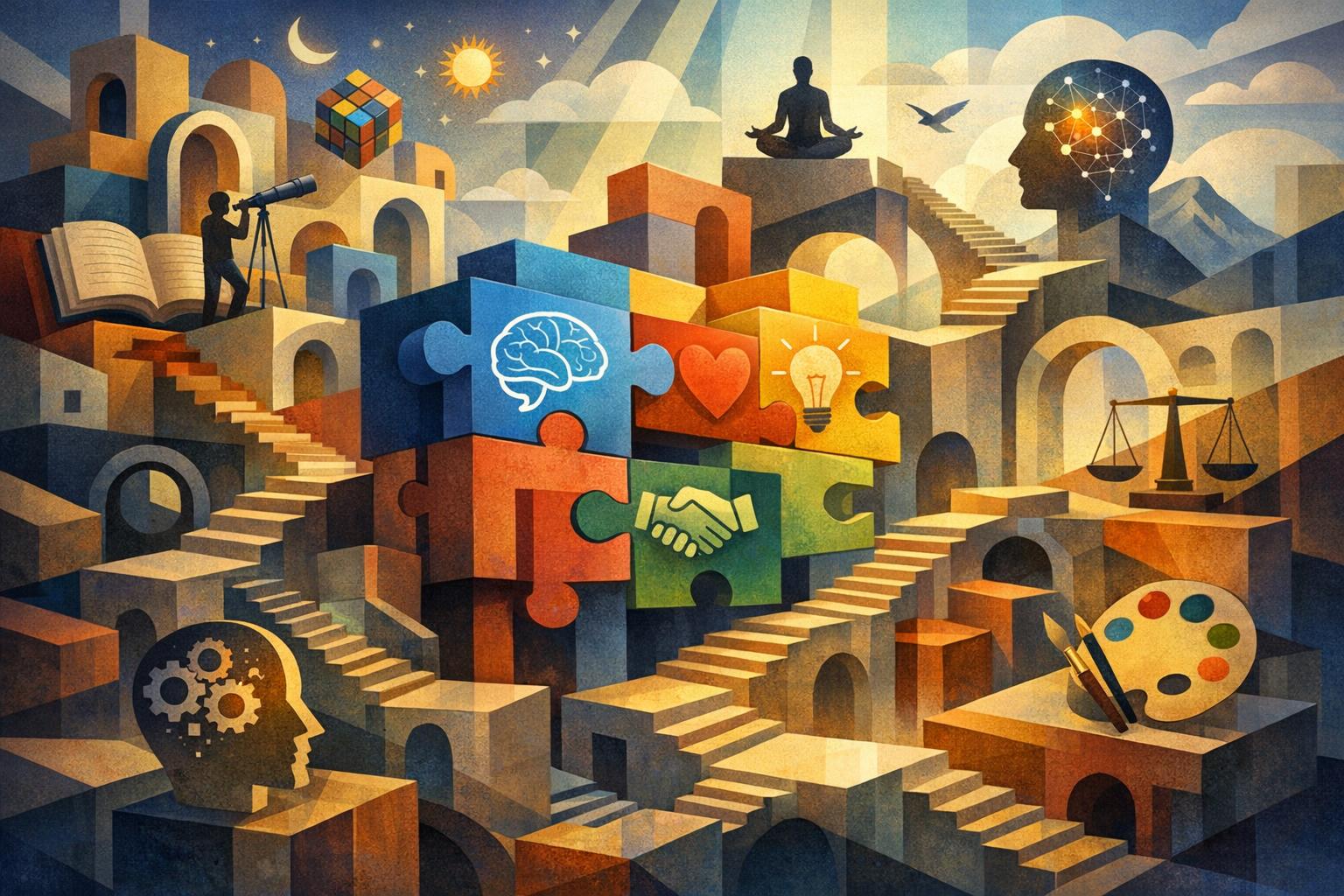
Psychologist Howard Gardner introduced a revolutionary idea that challenges the narrow focus on IQ. He identified seven distinct types of intelligence, each reflecting different ways minds work and perceive the world. Understanding these broadens our perspective on what it means to be intelligent.
1. Linguistic Intelligence: This involves facility with language, both written and spoken. People strong in this area enjoy reading, storytelling, and playing with words.
2. Logical-Mathematical Intelligence: This type is characterized by the ability to analyze problems logically, perform mathematical operations, and recognize patterns and relationships.
3. Bodily-Kinesthetic Intelligence: This reflects competence in physical control and coordination. Athletes, dancers, and craftsmen often excel in this intelligence.
4. Spatial Intelligence: This type involves thinking in images and visualizing with the mind’s eye. Those who engage well with puzzles, drawing, or building models commonly possess strong spatial intelligence.
5. Musical Intelligence: This intelligence relates to sensitivity to sounds, rhythms, tones, and musical patterns. People with this gift often detect nuances others miss.
6. Interpersonal Intelligence: This refers to the ability to understand and interact effectively with others. Strong leaders often exhibit this intelligence.
7. Intrapersonal Intelligence: This type is about self-awareness and understanding one’s own emotions, motivations, and thoughts.
Of these seven, IQ tests typically measure only linguistic, logical-mathematical, and spatial intelligence. The other four remain largely unassessed, yet they are essential to the fullness of human intellect and capability.
The Integration of Intelligence: Toward a Renewed and Sound Mind

Recognizing the multiplicity of intelligences highlights an important truth: true intelligence involves the integration of diverse cognitive and emotional faculties rather than isolated strengths. Someone may excel in logical reasoning but be less capable in interpersonal understanding or bodily coordination, and vice versa.
Moreover, intelligence is not merely about innate ability but also about how one employs those abilities in real life. The difference between partial use of the brain’s capabilities and a holistic, integrated approach is significant. A person who harmonizes these intelligences, using both their cognitive and emotional strengths, can navigate complex life challenges with greater wisdom and clarity.
Cultivating a renewed mind requires deliberately exercising all areas of intelligence, encouraging harmony among faculties rather than favoring only a few. Such renewal fosters sound judgment and deeper understanding, enabling a person to respond to life with resilience and insight.
This perspective calls us to reconsider how intelligence is valued and measured. It invites educators, leaders, and individuals to embrace a fuller, more balanced picture—one that appreciates talents beyond traditional academic metrics and cultivates a mind renewed and sound in its comprehension.
“Do not be conformed to this world, but be transformed by the renewal of your mind, that by testing you may discern what is the will of God.” (Romans 12:2)
This scriptural insight underscores that the process of renewing the mind goes beyond knowledge—it involves transformation that produces clarity, sound judgment, and stability in thought and action.


